Layer 4 of 4
The inner core: a solid iron ball as hot as the Sun
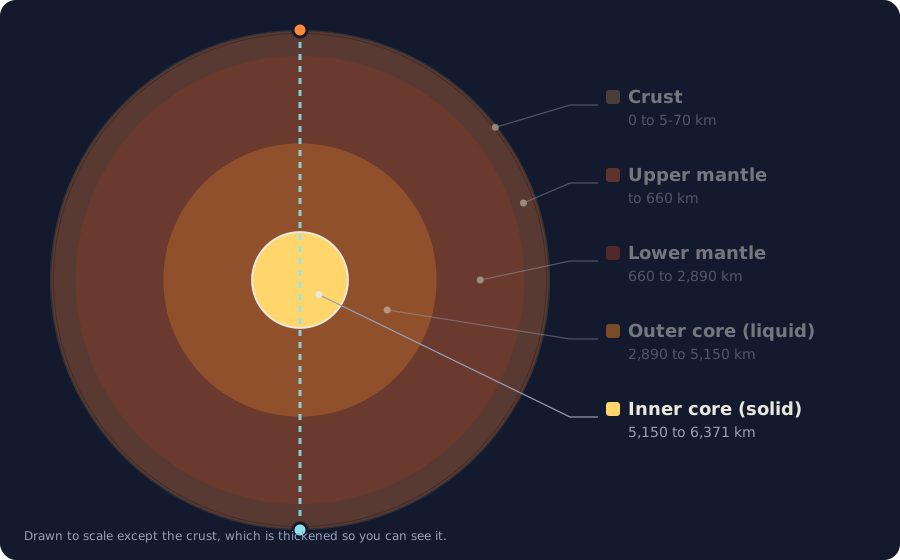
At the very center of the planet sits a ball of iron about 70% the size of the Moon. It is as hot as the surface of the Sun, and it is solid.
Hot as the Sun, yet solid
The inner core is made of iron with some nickel and a few percent of lighter elements. Its temperature is estimated at around 5,400 °C, similar to the surface of the Sun. At the surface, iron melts at 1,538 °C. The reason it stays solid is pressure: between 330 and 360 gigapascals, over three million times the air pressure you feel now. Squeezed that hard, iron atoms are locked into a crystal and cannot flow, whatever the temperature.
Discovered by Inge Lehmann
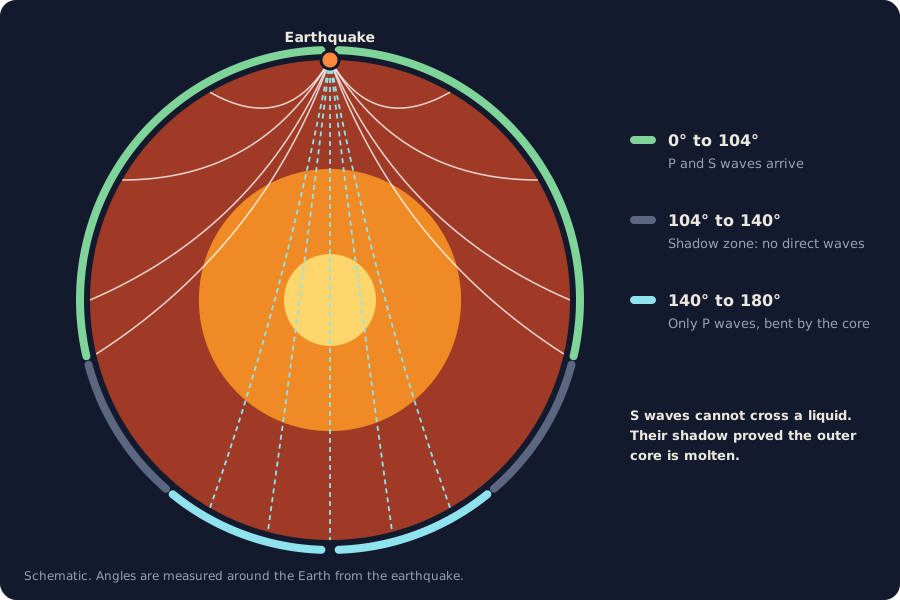
Until the 1930s scientists thought the whole core was liquid. The Danish seismologist Inge Lehmann studied recordings of a 1929 earthquake in New Zealand and noticed faint P waves arriving in places where the liquid core should have bent them away. In a 1936 paper with one of the shortest titles in science, P′, she argued that the waves were bouncing off a solid ball inside the liquid core. She estimated its radius at 1,400 km; the modern value is 1,221 km. Lehmann lived to 104 and became the first woman to receive the William Bowie Medal, the highest honor of the American Geophysical Union.
Still growing
As the Earth slowly cools, liquid iron from the outer core freezes onto the inner core, so it grows by roughly a millimeter per year. The freezing releases heat and leaves lighter elements behind in the liquid, and both help drive the currents that power the magnetic field. The inner core may be surprisingly young: estimates range from about half a billion to two billion years, while the Earth is 4.5 billion years old.
A core that spins at its own pace
Because the inner core floats in liquid, it can rotate slightly differently from the rest of the planet. In the 1990s researchers reported it spinning a little faster than the surface. More recent studies suggest it sped up and slowed down in a cycle lasting decades, and that around 2009 it began lagging behind. The debate is not settled, which shows how hard it is to study something 5,000 km away that nobody will ever visit.
Inner core facts
- Radius: about 1,221 km (the Moon's radius is 1,737 km)
- Share of Earth's volume: under 1%; share of its mass: about 1.7%
- Density: about 13 g/cm³, heavier than lead
- Temperature: about 5,400 °C; pressure: 330 to 360 GPa