Heat
Why is the inside of the Earth still hot?
A cup of coffee goes cold in twenty minutes. The Earth has been cooling for four and a half billion years and its center is still about as hot as the surface of the Sun.
How much heat is escaping
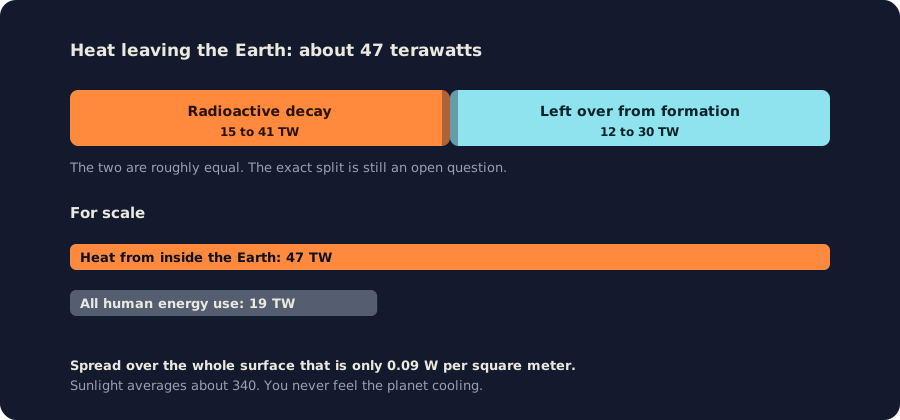
Add up the heat flowing out of every square meter of sea floor and continent and you get about 47 terawatts, give or take 2. That is more than twice the power used by all of human civilization. Yet you never feel it, because it is spread over the whole planet: about 0.09 watts per square meter, while sunlight delivers an average of around 340. The ground under your feet is losing heat roughly a thousand times slower than the Sun is adding it.
Half of it is left over from the beginning
The Earth was born hot. It grew by collisions, and every rock that hit it arrived with kinetic energy that turned into heat. Then the iron separated out and sank to the middle, and falling iron releases gravitational energy, which heats everything on the way down. A late giant impact, the one that probably made the Moon, melted much of the planet again. The young Earth had a magma ocean at the surface, and some of that original heat is still working its way out.
The other half is being made right now
The rest comes from radioactive decay. Four isotopes do nearly all the work: uranium-238, uranium-235, thorium-232 and potassium-40. They are long lived, which is exactly why they are still here after 4.5 billion years.
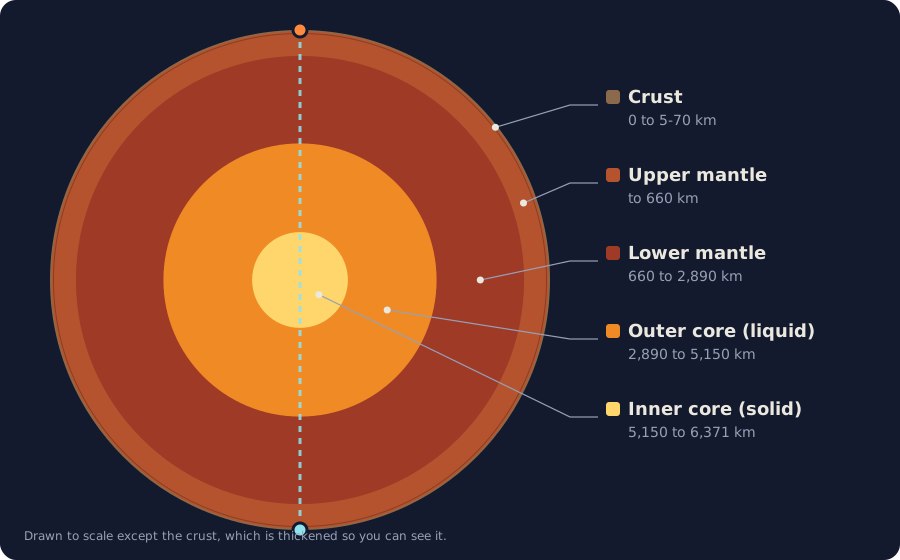
There is a surprise in where they sit. These elements do not mix well into iron, so they were largely left behind when the core formed. Most of the planet's radioactivity is in the crust and mantle, not in the core. The core is hot because it was hot, and because the mantle above it insulates it.
| Source | Estimated share of the 47 TW |
|---|---|
| Radioactive decay | roughly 15 to 41 TW |
| Heat left over from formation | roughly 12 to 30 TW |
How you weigh the radioactivity of a planet
You cannot sample the mantle, so physicists count geoneutrinos. Radioactive decay deep inside the Earth releases antineutrinos, which stream out through thousands of kilometers of rock as if it were not there. Detectors built in mines and under mountains, KamLAND in Japan and Borexino in Italy, catch a handful of them and work backwards to how much uranium and thorium the planet contains. It is the only direct measurement of the inside of the Earth that does not rely on earthquakes.
Why it cools so slowly
Rock is a poor conductor of heat, and the Earth is enormous compared with its surface. Most of the heat does not seep out by conduction at all; it rides up on slow-moving rock. The mantle convects, hot material rises, cooler material sinks, and plate tectonics carries heat to the surface where it escapes at mid-ocean ridges and volcanoes. Even so, the planet is only cooling by around 100 °C per billion years.
What the leftover heat does for us
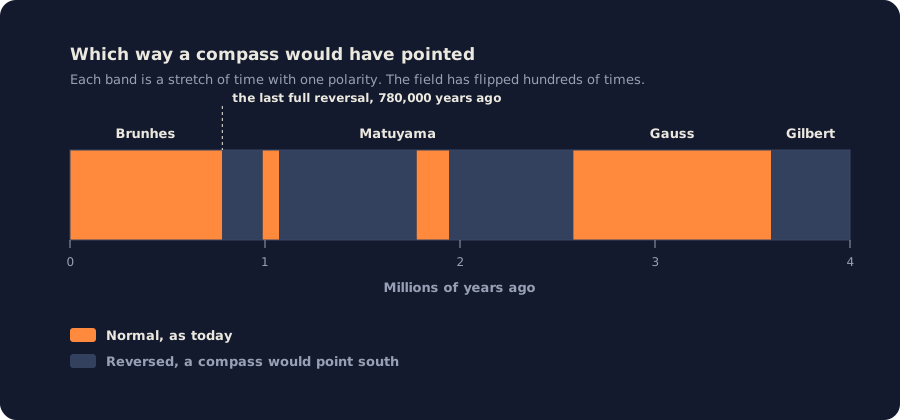
That slow leak is not a curiosity, it is the engine of the planet. It drives the convection that moves continents, builds mountains and recycles the sea floor. It keeps the outer core liquid and stirring, which is what generates the magnetic field. A cold Earth would be a geologically dead one, with no plate tectonics and no magnetic shield.