Magnetism
The magnetic field made by liquid iron
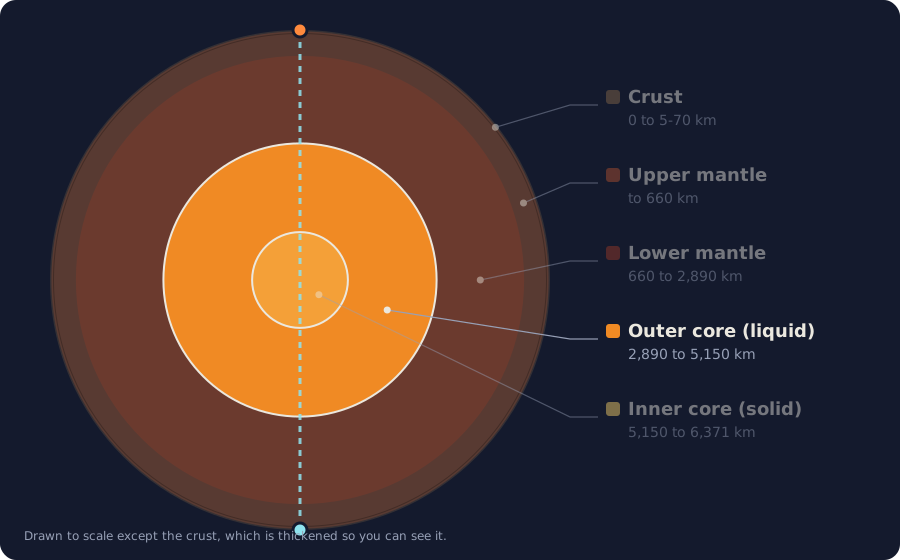
Your compass needle is lining up with something 2,900 km beneath your feet: an ocean of liquid iron stirring itself into an electromagnet.
A dynamo in the core
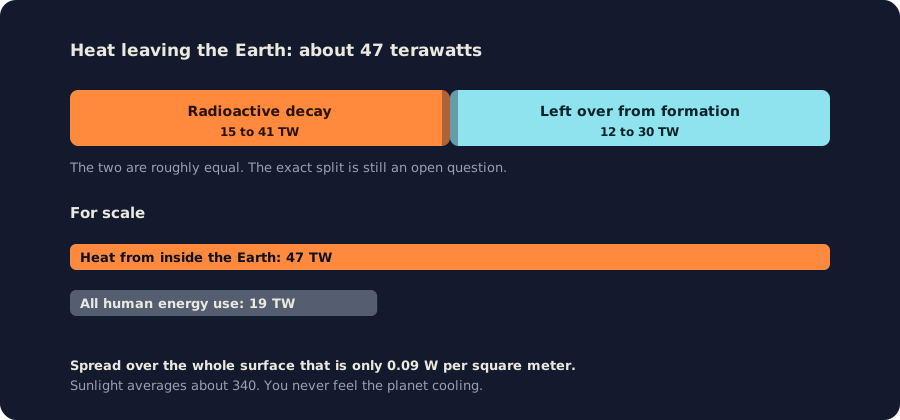
The field is not made by a lump of magnetized iron. Iron loses its magnetism when it gets hot, long before core temperatures. What happens instead is a geodynamo. Heat escaping the inner core stirs the liquid iron of the outer core, the planet's rotation twists that flow into spirals, and moving metal generates electric currents that sustain a magnetic field, which in turn keeps the currents going. It is self-running, and it has been running for billions of years.
At the surface the result is modest: 30 to 60 microtesla, depending on where you stand. A fridge magnet held against your skin is a hundred times stronger. The field's strength is not the point; its reach is. It extends tens of thousands of kilometers into space and deflects the solar wind, the stream of charged particles from the Sun.
The poles do not stay put
Magnetic north is not geographic north, and it does not sit still. Through the 1900s the north magnetic pole crept across the Canadian Arctic at about 10 km a year. By 2003 it was moving at around 40 km a year, heading for Siberia, and it has kept accelerating. Navigation systems that rely on magnetic bearings need their models updated on a schedule because of it.
The field is weakening, and there is a soft spot
Since measurements began in the 1800s the strength of the main dipole has been falling by roughly 6% a century. Over the South Atlantic the field is especially weak, a region called the South Atlantic Anomaly. Satellites passing through it take more radiation than usual, and some switch off sensitive instruments as they cross.
And every so often it flips
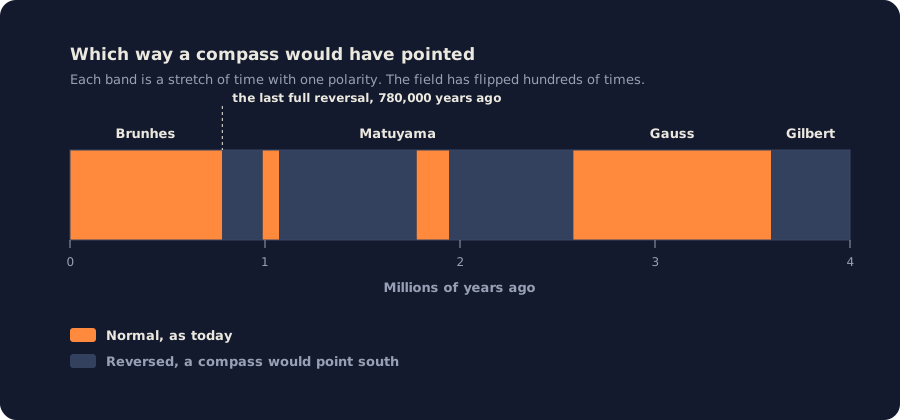
The most startling thing about the field is that it reverses. North becomes south, and a compass that survived the change would point the other way. The last full reversal was 780,000 years ago, the Brunhes-Matuyama reversal, and there have been at least 183 of them in the past 83 million years, an average of about one every 450,000 years. Average is a weak word here: the intervals are wildly irregular, and at one point in the Cretaceous the field held one polarity for some 40 million years.
A flip is not instant. Most estimates put a transition at 1,000 to 10,000 years, and a 2019 study argued the last one took around 22,000. There are also near misses. About 41,000 years ago, during the Laschamp event, the field collapsed to an estimated 5% of its usual strength, wandered, and then recovered without completing a reversal.
Should anyone worry?
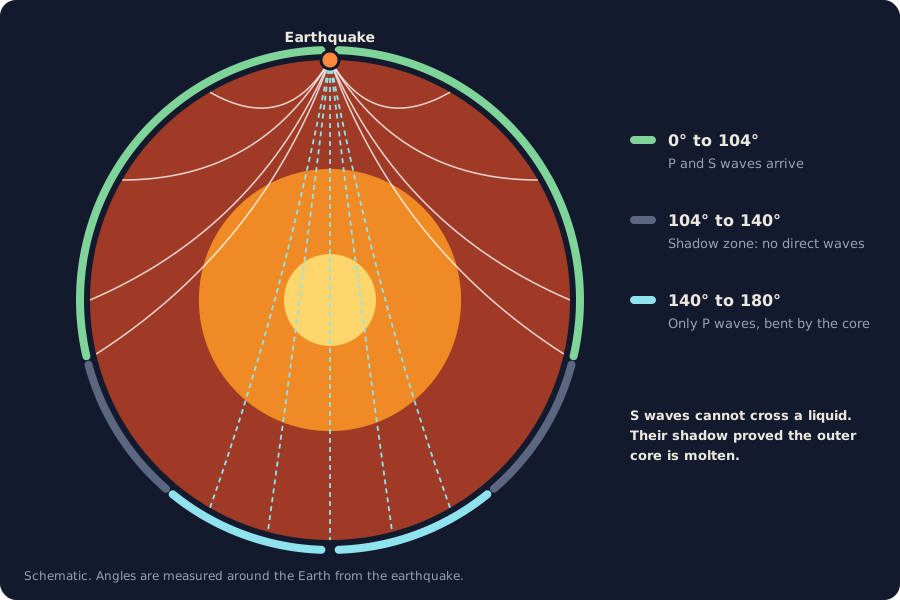
The honest answer is that it is worth studying and not worth losing sleep over. Reversals have happened hundreds of times during the history of complex life, and statistical work has found no correlation between them and mass extinctions. Our ancestors lived through the Laschamp event. What a weak field would affect is technology: satellites, power grids and anything else exposed to space weather.
How we know all of this
Lava and sediment record the direction of the field as they solidify, freezing a compass reading in place. When the sea floor spreads at a mid-ocean ridge, new crust records the field as it forms, so the ocean floor is striped with alternating magnetism, symmetrically on both sides of the ridge. Those stripes were among the strongest pieces of evidence for plate tectonics, and they are how the reversal timescale was built.